
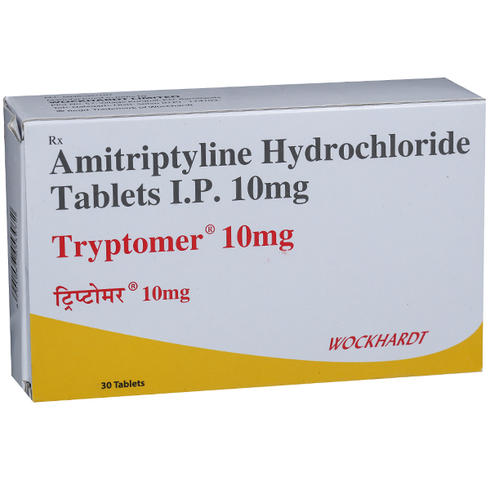
Tryptomer 10 mg Tablet (30 Tab)
 Rx Required
Salt Composition: Amitriptyline (10mg)
Expiry Date: 01/2028

Enquire
Inclusive of all taxes
30 Tab
 Prescription Required
Tryptomer 10 mg Tablet (30 Tab)
30 Tab
Amitriptyline
Salt Composition
Amitriptyline (10mg)
Storage
Below 25°C
Expiry Date
01/2028
Marketer
dr. reddy's laboratories ltd.
Brand
Dr. Reddy's Laboratories Ltd.
 Prescription Required
Amitone 10 mg Tablet (10 Tab)
10 Tab
Amitriptyline
Salt Composition
Amitriptyline (10mg)
Storage
Below 25°C
Expiry Date
01/2028
Marketer
Intas Pharmaceuticals Ltd.
Brand
Intas Pharmaceuticals Ltd.

MAGIC DEALS
Enquire
Apply Promo Code
Available CouponsTryptomer 10 mg Tablet (30 Tab)
Inclusive of all taxes

In Stock

Authorized

Global Reach

Verified Logistics
The price displayed is inclusive of applicable taxes. Any additional fee (such as shipping fee, handling and/or platform fee etc.) will be clearly disclosed before you complete your purchase.
About The Product
Overview
The Tryptomer 10 mg tablet contains amitriptyline hydrochloride, a tricyclic antidepressant with sedative effects. It is a prescription-based medicine.
Tryptomer 10mg tablet blocks the re-uptake of the brain chemicals noradrenaline and serotonin. A sedative effect may come before the antidepressant effect, and a full effect can take up to 30 days.
Tryptomer 10 mg Tablet is an antidepressant known as a tricyclic. The Tryptomer 10mg tablet is mainly prescribed for depression, nerve pain management, and to prevent migraine headache occurrences.
With the increased levels of serotonin and norepinephrine, it effectively relieves mood and boosts happiness.
Quick Product Facts
Item | Detail |
Generic name | Amitriptyline hydrochloride |
Strength and form | 10 mg film-coated tablet |
Maker and pack | Wockhardt: strip of 30 tablets |
Drug class | Tricyclic antidepressant |
Route | Oral |
Boxed warning | Suicidality and antidepressant drugs |
Storage | Store at room temperature, strictly below 30°C, in a tight, light-resistant container. |
Prescription status | Prescription medicine. |
Price control | Subject to applicable ceiling price regulations |
Price | The price of the Tryptomer 10 mg tablet varies depending on the pharmacy, location, and manufacturing. It is not fixed. |
Uses and Indications
- The Tryptomer 10 mg tablet is used to get relief from the symptoms of depression.
- Endogenous depression is more likely to improve than other depressive states.
- Amitriptyline is not approved for bipolar depression and is not approved for use in children.
- The tablet is used to manage nerve pain and also helps in migraine prevention.
- Your doctor decides what is right for you and at what dose.
- Do not use leftover Tryptomer 10 mg tablets for a different problem without advice.
How It Works
Amitriptyline present in the Tryptomer 10 mg tablet stops nerve cells from taking back noradrenaline and serotonin, which keeps those chemicals active for longer. It has an antidepressant effect. It is not an MAO inhibitor and is not a stimulant.
The body absorbs it quickly and breaks it down in the liver. Almost all of the dose leaves in the urine are inactive conjugates. A liver enzyme called CYP2D6 does much of the work, and about 7% to 10% of Caucasians are slow metabolizers. In them, drug levels can be up to 8 times higher at usual doses.
Clinical Evidence
Tryptomer 10 mg tablet contains amitriptyline, which has been clinically studied for depression, neuropathic pain, and migraine prevention. Clinical guidelines, including NICE, recommend amitriptyline as one of the first-line treatment options for neuropathic pain.
Evidence also supports its use in preventing migraines and managing chronic tension-type headaches. However, the quality of evidence varies across conditions, and treatment should be individualized by a healthcare professional.
Side Effects
The label lists side effects by body system without frequencies. The most familiar come from the atropine-like (anticholinergic) action: dry mouth, constipation, blurred vision, and trouble passing urine.
System | Side Effects |
Anticholinergic | Dry mouth, constipation, blurred vision, urinary retention, raised eye pressure, paralytic ileus, high temperature |
Nervous system | Drowsiness, dizziness, headache, fatigue, tremor, confusion, insomnia, nightmares, numbness or tingling, seizures, hallucinations |
Heart | Palpitations, fast heartbeat, low blood pressure on standing, fainting, rhythm and conduction changes, heart attack, stroke |
Hormones and weight | Weight gain or loss, changed sex drive, impotence, breast swelling in men or women, raised or lowered blood sugar |
Stomach and liver | Nausea, vomiting, poor appetite, bad taste, black tongue, diarrhea, rarely hepatitis |
Allergy and skin | Rash, hives, sun sensitivity, swelling of the face and tongue |
Blood and salt | Bone marrow suppression, including agranulocytosis, low sodium, hair loss, and sweating |
Serious side effects
In short: serious effects are uncommon, but each needs quick action.
Suicidal thoughts and behavior: antidepressants raise the risk in children, teenagers, and young adults, mostly in the first months or after a dose change.
Serotonin syndrome: agitation, hallucinations, fever, sweating, tremor, stiff muscles, racing heart, and seizures, mainly when combined with other serotonin-raising drugs.
Low sodium (hyponatremia): headache, trouble concentrating, confusion, weakness, and unsteadiness, which can lead to falls. Older people and those on diuretics are at higher risk.
Angle-closure glaucoma: pupil widening can trigger an attack in people with narrow eye angles.
Heart rhythm: higher doses can cause rhythm disturbances and slower conduction.
Neuroleptic malignant-like syndrome: very rarely reported, with muscle rigidity, fever, confusion, and a fast heartbeat.
Mania: a depressed person with bipolar illness may switch into mania or hypomania.
Stopping suddenly: nausea, headache, and malaise. A gradual cut brings irritability, restlessness, and sleep or dream disturbance within two weeks. These are not signs of addiction.
Critical Safety Warning
Call your local emergency number now for:
The boxed warning says antidepressants increased suicidal thinking and behavior in children, adolescents, and young adults in short-term trials. Anyone who plans to start a Tryptomer 10 mg tablet should closely monitor the warning signs and symptoms. Suicidality, or unusual behavior, must be daily observed by family or carers. The Tryptomer 10 mg tablet should not be given with MAO inhibitors, including linezolid and intravenous methylene blue, or with cisapride, and is not recommended during the acute recovery after a heart attack. |
Dosage and How To Take It
The dose of the Tryptomer 10 mg tablet may differ depending on the condition of the patients.
Who | Dosage |
Outpatient adults, usual start | 75 mg a day in divided doses; may rise to 150 mg a day, with increases preferably in the late afternoon or at bedtime |
Outpatient adults, alternative start | 50 to 100 mg at bedtime, raised by 25 or 50 mg to a total of 150 mg a day |
Hospital patients | 100 mg a day, raised to 200 mg, and occasionally to 300 mg |
Adolescents and older adults | Lower doses. 10 mg three times a day plus 20 mg at bedtime may be enough. |
Maintenance | 50 to 100 mg a day, or 40 mg in some patients, which can be taken as one bedtime dose |
Children | Not recommended under 12; not approved in pediatric patients |
How long: Keep going on the maintenance dose for at least 3 months after you improve to lower the chance of relapse. When you are better, the dose is reduced to the lowest that keeps relief.
When it starts to work: Sedation can come first. A full antidepressant effect can take as long as 30 days.
Stopping: never stop suddenly. Your doctor reduces the dose gradually.
Before an operation: Where possible, the drug should be stopped several days before elective surgery. Tell the surgeon.
Supply: prescriptions are written for the smallest quantity that suits care to lower the overdose risk.
Food and drink: Tryptomer 10 mg can be taken with or without food. Avoid alcohol, as it may increase drowsiness and dizziness. Maintain a regular diet and stay hydrated.
Missed Dose
- Ask your doctor or pharmacist if you missed the dose of the Tryptomer 10 mg tablet.
- Do not take extra tablets to catch up, because overdose with this class of medicine can be fatal.
Safety Advice
Watch for anxiety, agitation, irritability, or unusual behavior.
May increase drowsiness and overdose risk.
May affect alertness and coordination.
Use cautiously with glaucoma, urinary retention, or seizure history.
Monitor patients with heart disease or thyroid disorders.
Screen for bipolar disorder, depression, and suicide history.
Use cautiously and monitor blood glucose.
Monitor confusion, drowsiness, constipation, and risk of falls.
Use only when potential benefits outweigh risks.
Discuss potential risks and benefits with a doctor.
Protect skin against possible photosensitivity.
Monitoring During Treatment
Check | Guidance | Why |
Mood and behavior | Close observation, with daily watching by family or carers early on and after dose changes. | Worsening, suicidality |
Heart | Watch people with cardiovascular disease closely. | Rhythm changes |
Sodium | Check if symptoms appear, especially in older people or those on diuretics. | Hyponatraemia |
Eyes | Some people may wish to be examined for narrow eye angles. | Glaucoma attack |
Blood sugar | Levels can rise or fall. | Changes in control |
Liver | Use with caution if the liver is impaired. | Slower clearance |
Blood levels | Not routine. They may help when toxicity or missed doses are suspected. Adjust by response, not by level | Toxicity, adherence |
Fact Box
Item | Detail |
Chemical class | Dibenzocycloheptadiene derivative; tricyclic antidepressant |
Break-down | N-demethylation and bridge hydroxylation; almost all leaves as glucuronide or sulphate conjugates in urine. |
CYP2D6 slow metabolizers | About 7% to 10% of Caucasians have up to 8 times higher drug levels |
Top outpatient dose in the label | 150 mg a day (hospital patients up to 300 mg) |
Boxed warning | Suicidality and antidepressant drugs |
Contraindications | Known hypersensitivity; MAO inhibitors; cisapride; acute recovery after a heart attack |
Children | Not approved; not recommended under 12 years of age |
Overdose | Can be fatal. Needs hospital monitoring of the heart for at least 6 hours |
Storage | 20 to 25 degrees Celsius, tight and light-resistant container |
Drug Interactions
Tell your doctor about every medicine and herbal product you take.
Drug / Class | Potential Interaction or Risk | What To Do |
MAO inhibitors | Risk of serious reactions. | Avoid; maintain a 14-day gap. |
Linezolid and methylene blue | May cause serious interactions. | Avoid combined use. |
SSRIs, SNRIs, and triptans | Risk of serotonin syndrome. | Monitor for symptoms. |
Tramadol, fentanyl, and lithium | May increase serotonin-related effects. | Use with caution. |
St. John's wort | May increase serotonin-related risks. | Avoid combined use. |
Fluoxetine, sertraline, and paroxetine | May increase amitriptyline levels. | Monitor side effects. |
Quinidine and cimetidine | May increase drug exposure. | Monitor treatment response. |
Alcohol and sedatives | May increase drowsiness. | Avoid alcohol. |
Anticholinergic medicines | May increase constipation and other side effects. | Use with caution. |
Guanethidine | May reduce its blood-pressure-lowering effect. | Monitor blood pressure. |
Epinephrine with local anaesthetics | May affect heart rhythm and blood pressure. | Use under medical supervision. |
Electroshock therapy | May increase treatment risks. | Inform your specialist. |
FAQs
The Tryptomer 10 mg tablet is amitriptyline, an antidepressant. Doctors also prescribe low doses for other conditions, such as nerve pain or migraine prevention.
Your doctor decides the reason and the dose for you.
References
Sandoz Inc. Amitriptyline hydrochloride tablets, USP, US prescribing information, revised 05/2025.
National Library of medicine. Amitriptyline .
Ministry of Health and Family Welfare. National List of Essential Medicines 2022 (CDSCO copy). .


Medical Disclaimer
Accurate, reviewed information to support informed healthcare decisions
Magicine's primary objective is to ensure that its customers receive accurate, genuine, and trustworthy information reviewed by medical experts.
The content on this website has been produced solely for informational purposes. This is not intended to take the place of medical advice and care provided by a licensed professional, though.
This information may not include all potential side effects, warnings, and details about specific lab tests, medications, and medical conditions. Please ask your doctor any questions you may have about any drug or disease.
Our goal is not to replace or substitute for the doctor-patient relationship, but to uphold and strengthen it.


